As I read through"Norms and Nobility," Piaget's "The Child" and Dewey's "Experience and Education," I keep coming back to why the Vanguard Method is so effective in creating a whole learning experience.
David Bednar captured the heart of what whole or complete education is when he outlined the process in his book "Increase in Learning." Simply put, the learning process is as follows:
--Knowledge: information acquired without context
--Understanding: information taken, considered and given context, allowing the individual to make meaningful connections with the knowledge
--Intelligence: once that understanding it taken within, an individual should be given agency and accountability to act on that understanding to create intelligence.*
 Piaget references the power of this method of learning when suggesting that "socialization" (see post on "Piaget: The Child") as a component of mental development requires that the student is interacting as much if not more than the instructor with the material. You can see practical application of this process in operating Vanguard Youth group classrooms where the student is sent home the week previous with a spring-board concept and they are expected to engage in the different steps of the learning process through the week as outlined by Bednar and come prepared to teach and share the following week in class. You never know where an individual's genius or talents will take the subject when presented in a safe environment of exploration! This also caters to the idea of Piaget that allowing a child to explore subjects free from externally created parameters gives wider range of possibility and perspective as a child/youth creates context and connections for the world around them.
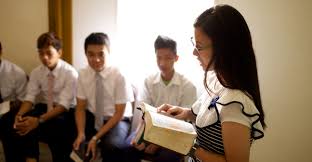 You can also see the effective application of this student-centered learning and teaching in the Church of Jesus Christ of Latter-day Saints and their "Come Follow Me" youth program. It is something of a Socratic method in which questions are presented and students are challenged to find their own answers and come and discuss their findings. Preparation not only engages the student more in the learning process but allows them to take the information that other's present and intelligently respond to, assimilate/incorporate or reject what is being presented.
An example of this is what I did with my children last year when studying ancient history. We came across the idea of the Seven Wonders while reading aloud Susan Wise Bauer's "Story of the World." We watched a youtube presentation on the process whereby the ancients arrived at what constituted a "wonder of the world." The next step was the truly wondrous one. I then asked the children to create their own "Prezis" on what they consider "7 Wonders," not isolating them to objects, timelines or geographic locations. What I saw over the next few weeks was powerful, meaningful education as all the children, from my 15 year old to my 8 year old, created and presented their own "7 Wonders Prezis" and taught each other. In the process they not only had to research (create understanding) but form their own views on what made something wondrous. When presented with the ideas of others, they were forced to re-evaluate their own as well as gain appreciation for the perspective of others. Their paradigms were also expanded as they saw the world from different angle's with wonders ranging from the Amazon to Extreme Sports to the LDS Restoration of the Gospel.
In "Norms and Nobility," Hick's proposes that meaningful education--nominative education (I will write a future article on this amazing book)-- happens when we encounter information (whether historical or otherwise) and ask ourselves questions like "why?" or "what would I do?" and not just memorize it (operative education). This challenging approach forces a student to become interactive with the material, not in order to pass judgement but to shape themselves.
 Dewey notes that it is important to not discard traditional education with its reverence or immersion in historical literature and information in favor of the progressive education movement which seeks to create a learning process exclusively made up of personal experimentation and analysis, "freed from the limiting scope of ancient learning." As I read his book "Experience and Education," I came to the conclusion that a person's individual experience is limited in nature and to complete disregard the wealth of experience contained in historical data is a waste. One student cannot possibly experience the depravity of a concentration camp, the thrill of climbing Everest nor command the attention and respect of thousands of troops from horseback as did Genghis Khan. While they do not have to embrace everything that is taught by those who have experienced these events, if the student studies a range of original sources and meshes that with their own personal experiences, their ability expands to make accurate connections in realistic context without having to experience everything first hand.

It is this narrow experience that Piaget warns against in the development of intelligence of a child, where incorrect "fields" (or reference points) are reinforced by limited information. You can see the negative effect of this in tyrannical governments where information disseminated in education is limited and driven by agendas. Perhaps the Vanguard Method is an effective way to minimize agenda's as imposed by mentors and teachers, governments or leaders. The role of a mentor cannot be minimized, as Dewey proposes, for to just turn a child loose on a world without direction is not always the most effective way for them to learn. Of course, this depends upon the age and vision of the student, of course. There is a time to follow self-directed study and a time to seek mentoring when a specific goal is in mind. But there is inherent value in an effective mentor who knows when to step in and when to step back.
The Vanguard Method allows a mentor to create an environment with where learning is largely governed by individual interest. One of the mentor's intents should be to broaden the student's ability to see things from different angles and giving opportunities for more in depth study and acquisition of "crust skills" for those students who seek it in a given area (Journeyman and Master level classes).
I feel like the Vanguard Method embraces all the ideals of these different authors so far and am excited to challenge and refine that idea as I continue to study!
*In "Thomas Jefferson Education for Teens," the authors give a similar outline of levels of learning in books by suggesting that level 1 is simple reading, level 2 is doing some type of writing or interpretive activity with it (book discussion) and level 3 is teaching others about it. I feel this is more limited in scope and choose to use Bednar's outline as the basis for more effective learning.
David Bednar captured the heart of what whole or complete education is when he outlined the process in his book "Increase in Learning." Simply put, the learning process is as follows:
--Knowledge: information acquired without context
--Understanding: information taken, considered and given context, allowing the individual to make meaningful connections with the knowledge
--Intelligence: once that understanding it taken within, an individual should be given agency and accountability to act on that understanding to create intelligence.*
Piaget references the power of this method of learning when suggesting that "socialization" (see post on "Piaget: The Child") as a component of mental development requires that the student is interacting as much if not more than the instructor with the material. You can see practical application of this process in operating Vanguard Youth group classrooms where the student is sent home the week previous with a spring-board concept and they are expected to engage in the different steps of the learning process through the week as outlined by Bednar and come prepared to teach and share the following week in class. You never know where an individual's genius or talents will take the subject when presented in a safe environment of exploration! This also caters to the idea of Piaget that allowing a child to explore subjects free from externally created parameters gives wider range of possibility and perspective as a child/youth creates context and connections for the world around them.An example of this is what I did with my children last year when studying ancient history. We came across the idea of the Seven Wonders while reading aloud Susan Wise Bauer's "Story of the World." We watched a youtube presentation on the process whereby the ancients arrived at what constituted a "wonder of the world." The next step was the truly wondrous one. I then asked the children to create their own "Prezis" on what they consider "7 Wonders," not isolating them to objects, timelines or geographic locations. What I saw over the next few weeks was powerful, meaningful education as all the children, from my 15 year old to my 8 year old, created and presented their own "7 Wonders Prezis" and taught each other. In the process they not only had to research (create understanding) but form their own views on what made something wondrous. When presented with the ideas of others, they were forced to re-evaluate their own as well as gain appreciation for the perspective of others. Their paradigms were also expanded as they saw the world from different angle's with wonders ranging from the Amazon to Extreme Sports to the LDS Restoration of the Gospel.
In "Norms and Nobility," Hick's proposes that meaningful education--nominative education (I will write a future article on this amazing book)-- happens when we encounter information (whether historical or otherwise) and ask ourselves questions like "why?" or "what would I do?" and not just memorize it (operative education). This challenging approach forces a student to become interactive with the material, not in order to pass judgement but to shape themselves.
Dewey notes that it is important to not discard traditional education with its reverence or immersion in historical literature and information in favor of the progressive education movement which seeks to create a learning process exclusively made up of personal experimentation and analysis, "freed from the limiting scope of ancient learning." As I read his book "Experience and Education," I came to the conclusion that a person's individual experience is limited in nature and to complete disregard the wealth of experience contained in historical data is a waste. One student cannot possibly experience the depravity of a concentration camp, the thrill of climbing Everest nor command the attention and respect of thousands of troops from horseback as did Genghis Khan. While they do not have to embrace everything that is taught by those who have experienced these events, if the student studies a range of original sources and meshes that with their own personal experiences, their ability expands to make accurate connections in realistic context without having to experience everything first hand.It is this narrow experience that Piaget warns against in the development of intelligence of a child, where incorrect "fields" (or reference points) are reinforced by limited information. You can see the negative effect of this in tyrannical governments where information disseminated in education is limited and driven by agendas. Perhaps the Vanguard Method is an effective way to minimize agenda's as imposed by mentors and teachers, governments or leaders. The role of a mentor cannot be minimized, as Dewey proposes, for to just turn a child loose on a world without direction is not always the most effective way for them to learn. Of course, this depends upon the age and vision of the student, of course. There is a time to follow self-directed study and a time to seek mentoring when a specific goal is in mind. But there is inherent value in an effective mentor who knows when to step in and when to step back.
The Vanguard Method allows a mentor to create an environment with where learning is largely governed by individual interest. One of the mentor's intents should be to broaden the student's ability to see things from different angles and giving opportunities for more in depth study and acquisition of "crust skills" for those students who seek it in a given area (Journeyman and Master level classes).
I feel like the Vanguard Method embraces all the ideals of these different authors so far and am excited to challenge and refine that idea as I continue to study!
*In "Thomas Jefferson Education for Teens," the authors give a similar outline of levels of learning in books by suggesting that level 1 is simple reading, level 2 is doing some type of writing or interpretive activity with it (book discussion) and level 3 is teaching others about it. I feel this is more limited in scope and choose to use Bednar's outline as the basis for more effective learning.
Comments
Post a Comment